
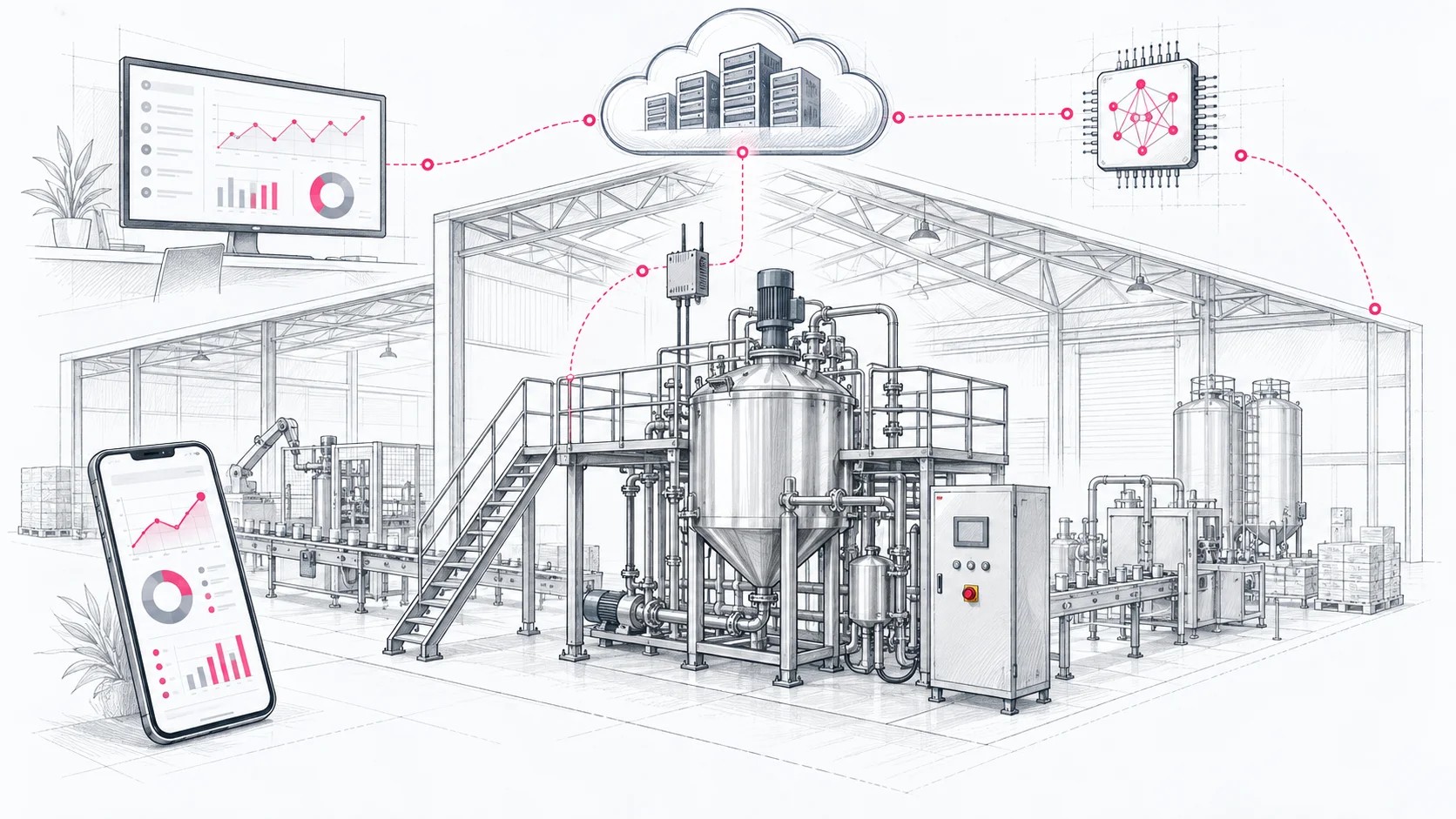
Atyaf Teknoloji is contributing to the development of WHITE Industrial Ecosystem through a technology partnership that brings together its expertise in software engineering, information systems, and cloud solutions with WHITE’s industrial expertise. The project aims to build a configurable ecosystem connecting equipment, production processes, quality, and factory data to support monitoring, analysis, and decision-making.
The collaboration starts with a practical question: how can the data generated by equipment and operations every day become understandable information that reaches the right person and helps them make a better decision?
From scattered data to connected operational context
Within a factory, information may be spread across controllers, production records, quality test results, and management systems. Each source has value, but understanding what is happening requires connecting these sources to their context: which batch was produced? Under what operating conditions? Were there quality deviations? What events preceded them?
WHITE Industrial Ecosystem is being developed to establish these connections, making equipment and process data a foundation for clearer operational visibility. The scope of each implementation is determined by the factory’s needs, available interfaces, data quality, and approved permissions.
Connecting data means more than collecting it on one screen. The US National Institute of Standards and Technology (NIST) describes the digital thread as enabling information reuse and traceability across the product lifecycle, particularly between engineering, manufacturing, and quality. This highlights the importance of preserving data’s meaning and relationship to a process, not just its individual values. NIST — Digital Thread for Smart Manufacturing
Atyaf’s role: Engineering the ecosystem’s digital foundation
Atyaf contributes as the technology partner specializing in information systems, software, and cloud solutions. At the heart of this role is participation in translating industrial and operational requirements into software architecture that can be extended, integrated, and maintained.
This means combining an understanding of operations with technical solution design, while considering the relationships between data sources, user interfaces, and digital services. The interface an operator or manager sees needs organized data, clear permissions, and reliable integrations behind it.
The architecture under development includes cloud, on-premises, and hybrid hosting options, alongside pathways for management, tablet, and mobile interfaces, according to each project’s requirements. The aim is to deliver relevant information through tools suited to each team’s responsibilities and operating environment.
How can connected information help day-to-day work?
As an illustration—not a description of a feature already released—investigating a batch-quality deviation could start with a test result, then move to the batch record, operating conditions, and related events. A connected ecosystem’s value lies in giving specialists this context to review possible causes. Correlation alone does not establish causation or replace engineering judgment.
Industrial and software expertise working together
Developing an industrial ecosystem requires collaboration across disciplines: industrial, mechanical, and electrical engineering; control and quality systems; and software and data engineering.
The value of the WHITE–Atyaf partnership lies in bringing these disciplines together around shared operational requirements. Software decisions must reflect factory realities, while operational needs must be translated precisely into required data, exchange methods, automation boundaries, and ways to verify outputs.
Development therefore involves ongoing testing, structured releases, and review of operational feedback, enabling the ecosystem to evolve gradually around real needs.
Artificial intelligence grounded in factory data
The project’s vision includes using artificial intelligence to help analyze patterns and deviations, summarize events, and answer operational questions based on available data.
The usefulness of these capabilities depends on data quality, context, and performance validation. Equipment control permissions and safety functions remain within the relevant engineering systems: AI supports human review and decision-making and does not issue direct commands to equipment.
In the wider context, NIST’s AI Risk Management Framework offers a voluntary approach to incorporating trustworthiness into the design, development, use, and evaluation of AI systems. This helps explain why analytical capabilities need to be accompanied by questions about their limits and evaluation, rather than simply the presence of an AI model. NIST — AI Risk Management Framework
Security and risk considered from the outset
Information security policies, integration risk assessment, and data quality are part of the project’s development approach. This includes examining access permissions, information accuracy, consistency, and traceability, and defining controls appropriate to each implementation’s scope.
Industrial environments differ from ordinary business applications. NIST SP 800-82 addresses operational technology security alongside its distinctive performance, reliability, and safety requirements. This underscores the importance of assessing how a digital connection affects operations, rather than treating it simply as data transfer between two applications. NIST — Guide to Operational Technology Security
For Atyaf, this project reflects the meaning of a long-term technology partnership: understanding the problem, helping engineer the solution, then developing, maintaining, and improving it as operational needs evolve.
WHITE Industrial Ecosystem is currently under active development, with parts undergoing testing. Implemented and validated functions and integrations are defined for each project individually. WHITE handles inquiries and projects relating to the ecosystem.